SEO to GEO: The Market Shift, in Numbers
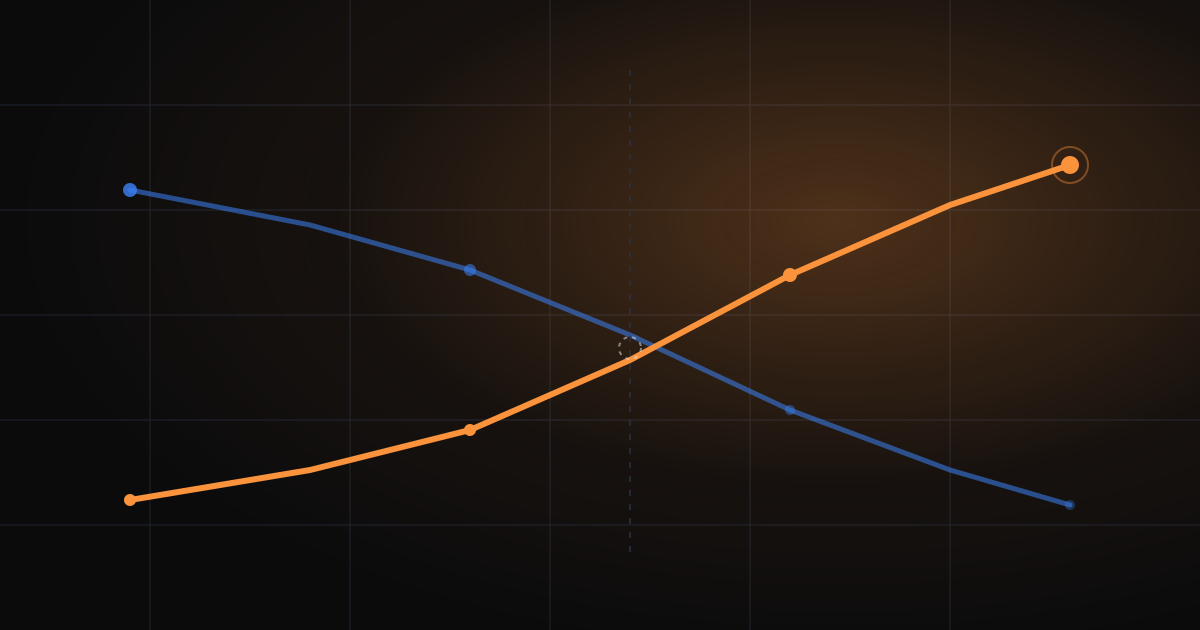
Discovery is moving from ranked results to generated answers: analysts forecast traditional search volume falling 25% by 2026, two-thirds of Google searches already end without a click, and the visitors who do click convert 4.4× better — because the decision now forms inside the answer, before any website is visited. Brands are no longer found; they are recommended.
This post collects the strongest published numbers behind that shift — forecasts, measured behavior, and an independent million-keyword test — so you can make the case with data instead of vibes.
The forecast: Gartner called it first, and called it twice
Back in February 2024, Gartner published two predictions that framed the whole category:
- −25% — traditional search engine volume by 2026, as queries move to AI chatbots and virtual agents.
- −50% — brands' organic search traffic by 2028, as consumers embrace generative AI-powered search.
A follow-up in 2025 added the adoption curve: 50% of all online searches will involve an AI assistant by 2028. Behind the forecast sat survey data pointing the same direction — 79% of surveyed consumers expected to use AI-enhanced search within a year, and 70% already placed at least some trust in generative AI results.
The behavior: measured, not predicted
Forecasts age badly; measured behavior doesn't. Three independent measurements from 2025–2026 show users deciding before they click:
- 80% of consumers rely on AI-written results for at least 40% of their searches — cutting organic traffic by an estimated 15–25% (Bain & Company, 2025, n=3,000).
- 68% of US Google searches now end without a single click, up from 58.5% in 2024 (SparkToro / Similarweb, 2026).
- 25% of Google searches now show an AI Overview — nearly double the rate of March 2025 (Conductor, 2026, 21.9M queries).
The sharpest single data point comes from Pew Research, which analyzed 68,879 real user searches: when an AI Overview appears, click-through on the results below it drops from 15% to 8% — a 47% relative decline. The discovery click fades; the click that remains is already decided.
The forecast, independently tested
In July 2026, Fractl and Search Engine Land published the largest independent test of Gartner's prediction so far: 1,010,848 keywords with at least 10K monthly searches each, across 379 brands, 8 verticals, and 35.4B in monthly search volume, paired with a survey of 1,004 US consumers.
The finding: 29% of high-volume search demand is in measurable decline — steeper than Gartner's 25% forecast. Total search volume is flat; people ask as much as ever. The queries are simply moving to answer engines.
Where the value flows: fewer clicks, worth more
The shift is not just erosion — the economics of the remaining clicks changed:
- 4.4× — AI search visitors convert 4.4× better than traditional organic visitors. They arrive pre-qualified by the answer (Semrush, 2025).
- 2028 — the projected crossover year when AI search visitors surpass traditional search visitors, sooner if AI Mode becomes Google's default (Semrush AI Search Study).
- +35% — higher organic click-through for brands cited inside AI Overviews (+91% on paid). Winning the answer lifts everything below it (Semrush AI Overviews Study, 2025).
- $33.7B — the projected GEO market by 2034, up from $848M in 2025, a 50.5% CAGR. 54% of US marketers plan GEO adoption within 6 months (Dimension Market Research / eMarketer, 2026).
The implication: visibility is earned in the answer
For twenty years, visibility meant rank. That proxy is dissolving: the model now states a preference directly, in prose, to a buyer who will probably never scroll past it. What matters is whether your brand is mentioned, how it's framed, and which sources the engines lean on when they describe your market — measured across every engine, not assumed from one screenshot.
That is precisely what Generative Engine Optimization is for, and why we built geopsy to track visibility, share of voice, and citations across ChatGPT, Gemini, Claude, and Perplexity, run over run. If you want to know where you stand today, start with the AI visibility audit checklist — or let geopsy measure it for you.
Sources
- Gartner — press release, Feb 19 2024; Predicts 2024 series; 2025 update
- Bain & Company — "Goodbye Clicks, Hello AI", Feb 2025
- Pew Research Center — AI Overviews behavioral study, Jul 2025 (n=68,879 searches)
- SparkToro / Similarweb — zero-click clickstream analysis, 2026
- Conductor — 2026 Benchmarks (21.9M queries)
- Fractl × Search Engine Land — 1M-keyword study, Jul 2026
- Semrush — AI Search Study, Jun 2025; AI Overviews Study, 2025
- Dimension Market Research / eMarketer — GEO market sizing, 2025–26
Originally published on the geopsy blog. Republishing or quoting? Please link the source: geopsy.ai/blog/seo-to-geo-market-shift/